How We Lost Communication to Entertainment
by Ploum on 2025-12-15
All our communication channels are morphed into content distribution networks. We are more and more entertained but less and less connected.
A few days ago, I did a controversial blog post about Pixelfed hurting the Fediverse. I defended the theory that, in a communication network, you hurt the trust in the whole network if you create clients that arbitrarily drop messages, something that Pixelfed is doing deliberately. It gathered a lot of reactions.
When I originally wrote this post, nearly one year ago, I thought that either I was missing something or Dansup, Pixelfed’s creator, was missing it. We could not both be right. But as the reactions piled in on the Fediverse, I realised that such irreconcilable opinions do not arise only from ignorance or oversight. It usually means that both parties have vastly different assumptions about the world. They don’t live in the same world.
Two incompatible universes
I started to see a pattern in the two kinds of reactions to my blog post.
There were people like me, often above 40, who like sending emails and browsing old-fashioned websites. We think of ActivityPub as a "communication protocol" between humans. As such, anything that implies losing messages without feedback is the worst thing that could happen. Not losing messages is the top priority of a communication protocol.
And then there are people like Dansup, who believe that ActivityPub is a content consumption protocol. It’s there for entertainment. You create as many accounts as the kinds of media you want to consume. Dansup himself is communicating through a Mastodon account, not a Pixelfed one. Many Pixelfed users also have a Mastodon account, and they never questioned that. They actually want multiple accounts for different use cases.
On the Fediverse threads, nearly all the people defending the Pixelfed philosophy posted from Mastodon accounts. They usually boasted about having both a Mastodon and a Pixelfed account.
A multiplicity of accounts
To me, the very goal of interoperability is not to force you into creating multiple accounts. Big Monopolies have managed to convince people that they need one account on each platform. This was done, on purpose, for purely unethical reasons in order to keep users captive.
That brainwash/marketing is so deeply entrenched that most people cannot see an alternative anymore. It looks like a natural law: you need an account on a platform to communicate with someone on that platform. That also explains why most politicians want to "regulate" Facebook or X. They think it is impossible not to be on those platforms. They believe those platforms are "public spaces" while they truly are "private spaces trying to destroy all other public spaces in order to get a monopoly."
People flock to the Fediverse with this philosophy of "one platform, one account", which makes no sense if you truly want to create a federated communication protocol like email or XMPP.
But Manuel Moreale cracked it for me: the Fediverse is not a communication network. ActivityPub is not a communication protocol. The spec says it: ActivityPub is a protocol to build a "social platform" whose goal is "to deliver content."
The ActivityPub protocol is a decentralised social networking protocol based upon the ActivityStreams 2.0 data format. It provides a client to server API for creating, updating and deleting content, as well as a federated server-to-server API for delivering notifications and content. (official W3C definition of ActivityPub)
No more communication
But aren’t social networks also communication networks? That’s what I thought. That’s how they historically were marketed. That’s what we all believed during the "Arab Spring."
But that was a lie. Communication networks are not profitable. Social networks are entertainment platforms, media consumption protocols. Historically, they disguised themselves as communication platforms to attract users and keep them captive.
The point was never to avoid missing a message sent from a fellow human being. The point was always to fill your time with "content."
We dreamed of decentralised social networks as "email 2.0." They truly are "television 2.0."
They are entertainment platforms that delegate media creation to the users themselves the same way Uber replaced taxis by having people drive others in their own car.
But what was created as "ride-sharing" was in fact a way to 1) destroy competition and 2) make a shittier service while people producing the work were paid less and lost labour rights. It was never about the social!
The lost messages
My own interpretation is that social media users don’t mind losing messages because they were raised on algorithmic platforms that did that all the time. They don’t see the point in trusting a platform because they never experienced a trusted means of communication.
Now that I write it, it may also explain why instant messaging became the dominant communication medium: because if you don’t receive an immediate answer, you don’t even trust the recipient to have received your messages. In fact, even if the message was received, you don’t even trust the recipient's attention span to remember the message.
Multiple studies have confirmed that we don’t remember the vast majority of what we see while doomscrolling. While the "view" was registered to increase statistics, we don’t have the slightest memory of most of that content, even after only a few seconds. It thus makes sense not to consider social media as a means of communication at all.
There’s no need for a reliable communication protocol if we assume that human brains are not reliable enough to handle asynchronous messages.
It’s not Dansup who is missing something. It is me who is unadapted to the current society. I understand now that Pixelfed was only following some design decisions and protocol abuses fathered by Mastodon. Pixelfed was my own "gotcha" moment because I never understood Instagram in the first place, and, in my eyes, Pixelfed was no better. But if you take that route, Mastodon is no better than Twitter.
Many reactions pointed, justly, that other Fediverse tools such as PeerTube, WriteFreely, or Mobilizon were just not displaying messages at all.
I didn’t consider it a big problem because they never pretended to do it in the first place. Nobody uses those tools to follow others. There’s no expectation. Those platforms are "publish only." But this is still a big flaw in the Fediverse! Someone could, using autocompletion, send a message pinging your PeerTube address and you will never see it. Try autocomplete "@ploum" from your Mastodon account and guess which suggestion is the only one that will send me a valid notification!
On a more positive note, I should give credit to Dansup for announcing that Pixelfed will soon allow people to optionally "not drop" text messages.
How we lost email
I cling to asynchronous reliable communications, but those are disappearing. I use email a lot because I see it as a true means of communication: reliable, asynchronous, decentralised, standardised, manageable offline with my own tools. But many people, even barely younger than me, tell me that email is "too formal" or "for old people" or "even worse than social network feeds."
And they are probably right. I like it because I’ve learned to use it. I apply a strong inbox 0 methodology. If I don’t reply or act on your email, it is because I decided not to. I’m actively keeping my inbox clean by sharing only disposable email addresses that I disable once they start to be spammed.
But for most people, their email inbox is simply one more feed full of bad advertising. They have 4 or 5 digit unread count. They scroll through their inbox like they do through their social media feeds.
Boringness of communications
The main problem with reliable communication protocols? It is a mostly solved problem. Build simple websites, read RSS feeds, write emails. Use IRC and XMPP if you truly want real-time communication. Those are working and working great.
And because of that, they are boring.
Communications protocols are boring. They don’t give you that well-studied random hit of dopamine. They don’t make you addicted.
They don’t make you addicted which means they are not hugely profitable and thus are not advertised. They are not new. They are not as shiny as a new app or a new random chatbot.
The problem with communication protocols was never the protocol part. It’s the communication part. A few sad humans never wanted to communicate in the first place and managed to become billionaires by convincing the rest of mankind that being entertained is better than communicating with other humans.
As long as I’m not alone
We believe that a communication network must reach a critical mass to be really useful. People stay on Facebook to "stay in touch with the majority." I don’t believe that lie anymore. I’m falling back to good old mailing lists. I’m reading the Web and Gemini while offline through Offpunk. I also handle my emails asynchronously while offline.
- Offpunk, an offline-first command-line browser (offpunk.net)
- There Is No Content on Gemini (ploum.net)
I may be part of an endangered species.
It doesn’t matter. I made peace with the fact that I will never get in touch with everyone. As long as there are people posting on their gemlogs or blogs with RSS feeds, as long as there are people willing to read my emails without automatically summarising them, there will be a place for those who want to simply communicate. A protected reserve.
You are welcome to join!
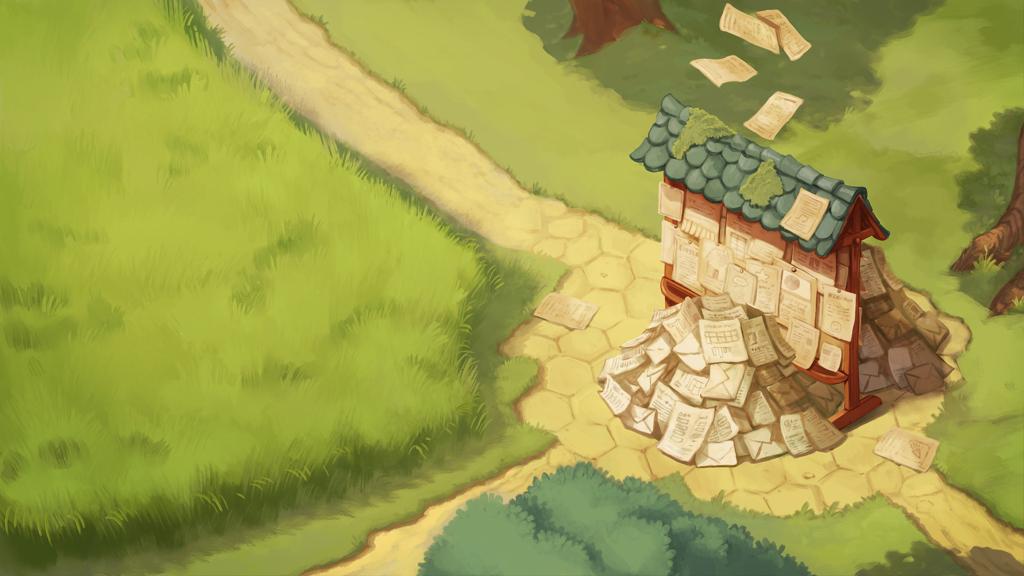
- Illustration of a message board piled with messages by David Revoy (CC By 4.0)
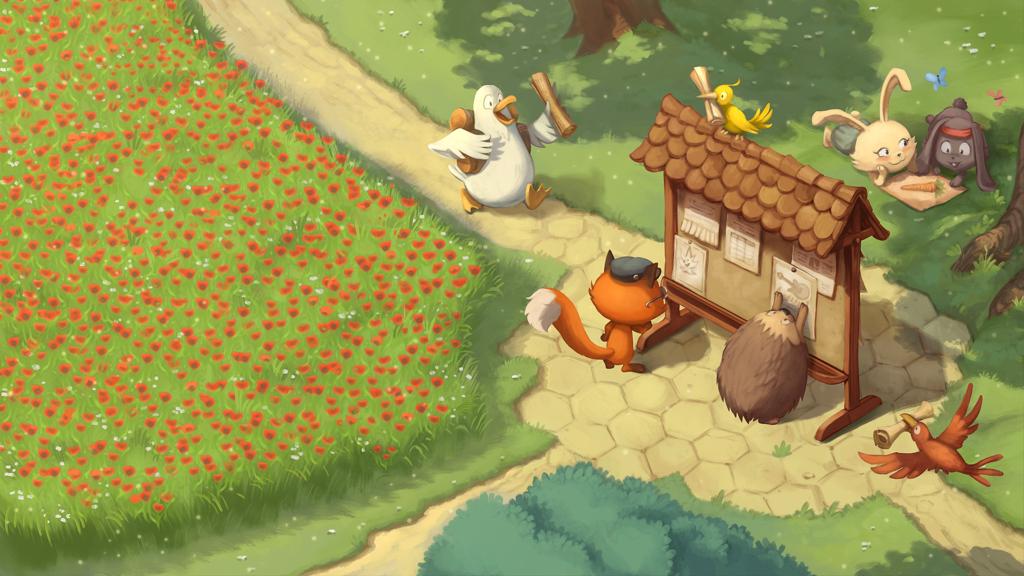
- Illustration of animal meeting at an intersection with messages by David Revoy (CC By 4.0)
About the author
I’m Ploum, a writer and an engineer. I like to explore how technology impacts society. You can subscribe by email or by rss. I value privacy and never share your adress.
I write science-fiction novels in French. For Bikepunk, my new post-apocalyptic-cyclist book, my publisher is looking for contacts in other countries to distribute it in languages other than French. If you can help, contact me!